
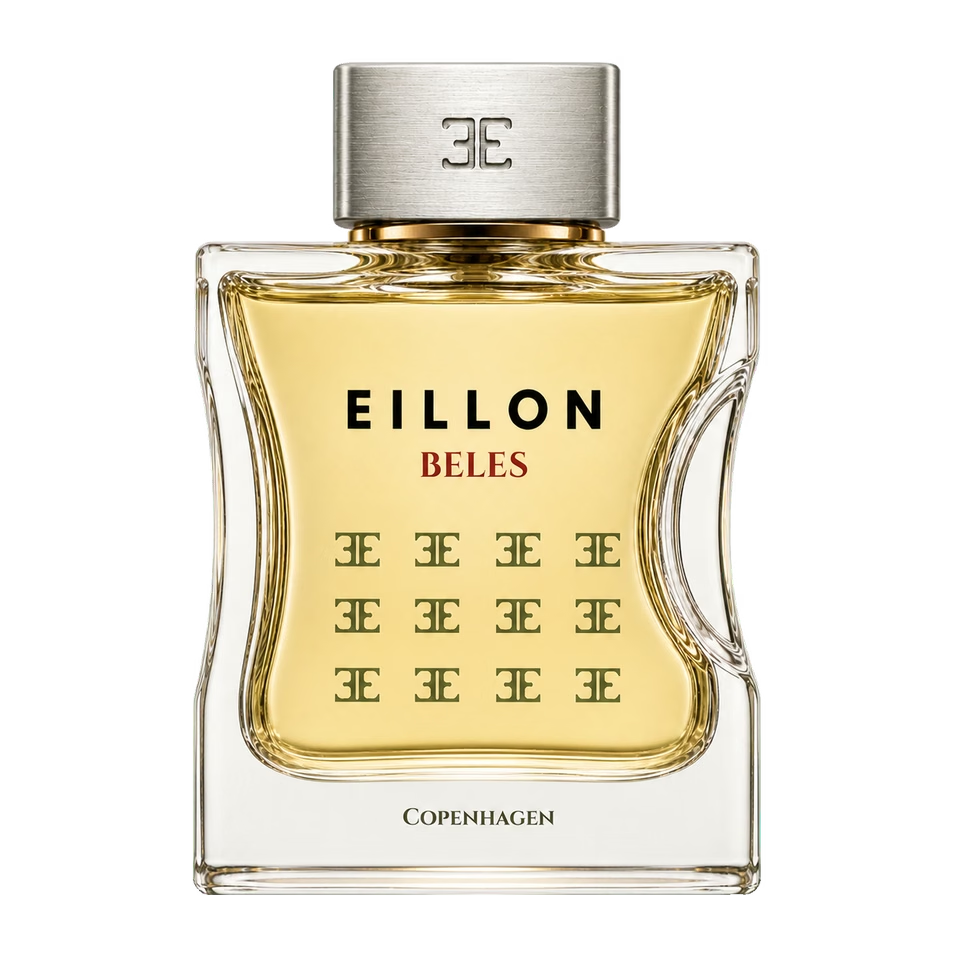
The current Beles packaging direction begins with a broad upright body of heavy clear glass. Two concave side channels shape a recessed inner reservoir, while a thick transparent base gives the object its visual weight. Pale liquid remains confined to the reservoir with a controlled high fill.
The cap
A wide brushed-silver cap keeps broad planar faces and a low controlled radius. One centered mirrored-E is engraved into the front; a thin warm-metal collar connects the cap to the glass.
The face
The front hierarchy reads EILLON, then BELES, then exactly twelve mirrored-E marks arranged four across by three down. COPENHAGEN is centered alone in the lower clear-glass area.
The monogram
The mirrored-E is used at two deliberate scales: one engraved cap mark and one precise four-by-three field on the bottle face. The same canonical vector carries into paper, textile, technical, shadow, and architectural pattern modes without being redrawn for each surface.
Made for parfum
Beles is an oil-rich parfum, not a thin alcohol-forward spray. The flacon is sized and weighted for a concentrate you apply with intention — each bottle hand-finished in Copenhagen and wrapped in stone-tone cloth and cream archival paper.
Object evidence file
| Bottle | Glass | Cap | Emblem | Lettering | Label state | Prototype/pilot status |
|---|---|---|---|---|---|---|
| Current Beles concept | Heavy clear body, sculpted side channels, recessed pale-liquid reservoir, thick clear base | Wide brushed-silver cap, one centered engraving, thin warm-metal collar | One cap mark plus an exact four-by-three field | Exact EILLON / BELES / twelve-mark field / COPENHAGEN hierarchy | Direct front architecture; no belt | Reference-led packaging concept, not documentary photography |
| BL-001 archive | Earlier pilot packaging | Earlier pilot cap | Earlier pilot artwork | Earlier pilot lettering | Archival evidence | Twenty-four real hand-filled pilot flacons documented separately |